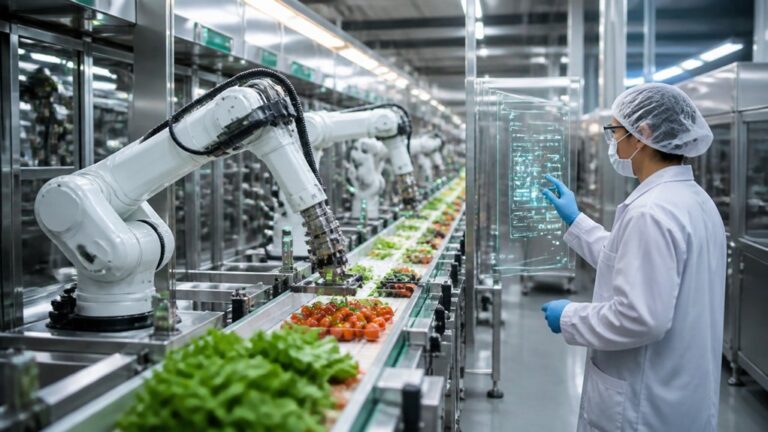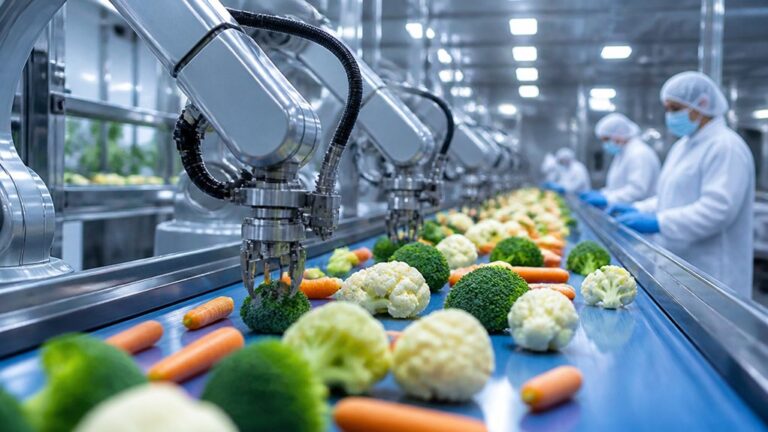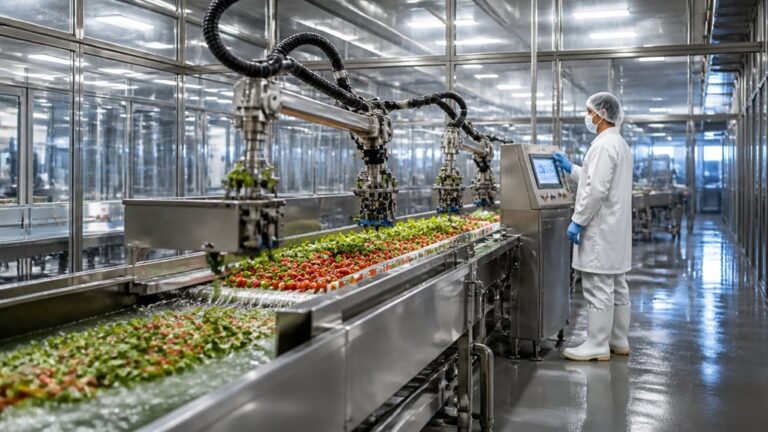
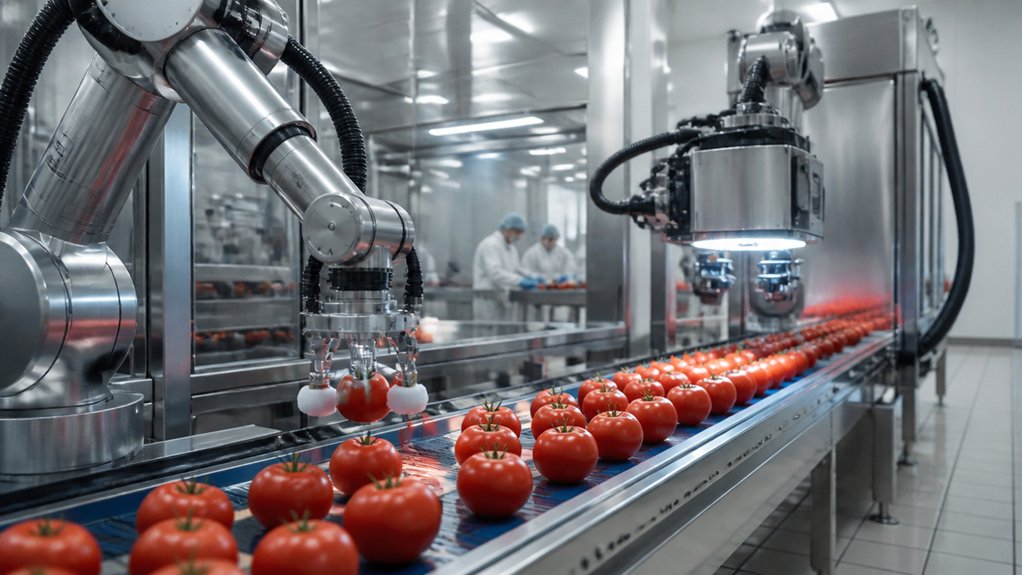
When you manage a food or beverage plant, robotics can reshape how products move from raw ingredients to finished packages. Vision systems and sensors help robots sort, handle, fill, and inspect products with consistent precision, while automated sanitation can reduce contamination risks. These systems can also limit waste and ease labor pressures, but their value depends on where and how you deploy them. The key is knowing which tasks to automate first—and what that change demands from your operation.
Where Do Food Processing Robots Fit on the Line?
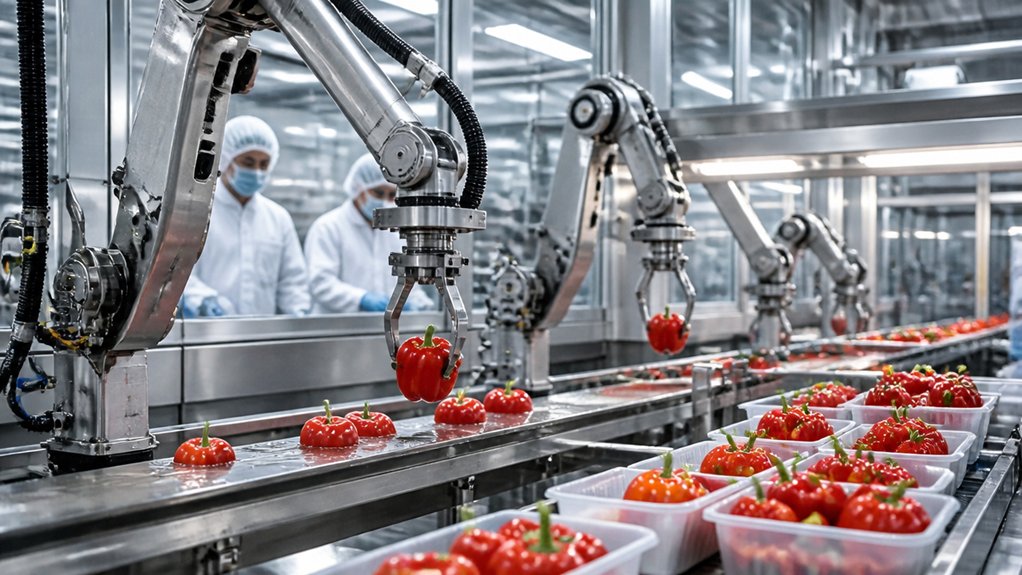
Food processing robots fit at points where automation can improve throughput, consistency, or worker safety—from ingredient handling and preparation to filling, packaging, and palletizing. You can place them at bottlenecks, repetitive stations, or tasks that expose employees to heat, sharp tools, or heavy loads.
At filling and sealing, vision-guided systems can verify placement and reduce variation; downstream, robotic case packing and palletizing can stabilize output as product formats change. Map each application against line speed, sanitation requirements, available floor space, and integration with existing controls.
Then assess how a robot affects labor allocation, maintenance demands, and the wider supply chain. Flexible cells can support short production runs, while clear employee training helps teams operate, clean, and troubleshoot equipment safely.
Track uptime, reject rates, and changeover time to confirm measurable gains.
How Do Food Processing Robots Sort and Prep Ingredients?
You can use vision systems and sensors to identify ingredients by type, size, and quality in real time. Robotic sorters then route each item to the right processing stream, reducing mix-ups and waste.
For precision prep, programmable tools can cut, peel, or portion ingredients to consistent specifications.
Ingredient Identification
Ingredient-identification systems combine machine vision, sensors, and AI to recognize items by features such as shape, color, size, and ripeness. You can use hyperspectral imaging to detect internal qualities, including moisture, sugar content, and defects invisible to standard cameras.
Sensor fusion lets your processing line distinguish ingredients even when lighting shifts or surfaces vary. Once a robot identifies an item, it can adjust its grip, cutting depth, or preparation settings to suit that ingredient. This precision helps you reduce damage and maintain consistent product specifications.
Identification data can also support nutritional analysis, revealing composition differences between batches, while ingredient profiles inform flavor enhancement by guiding recipe adjustments. As models learn from new samples, you can refine recognition accuracy, respond to changing supply, and make preparation decisions using reliable, measurable input.
Automated Sorting
Once vision and sensor data identify each ingredient, robotic sorting systems route it by size, shape, ripeness, quality, or intended use. You can use robotic arms, conveyor diverters, and air jets to separate products at high speed while minimizing bruising and cross-contamination.
Control software coordinates each action with real-time sensor updates, so the line adapts as ingredient flow changes. Defective items can be removed, while acceptable pieces move into distinct batches for different recipes or processing streams.
Some systems also weigh portions or group ingredients to meet production specifications. When you integrate automated taste testing, sensory measurements can help classify batches by flavor attributes and direct them toward suitable products.
This sorting intelligence supports robotic culinary operations, improves consistency, and gives you traceable decisions without replacing the specialized preparation steps that follow.
Precision Preparation
After sorting assigns each ingredient to its destination, robotic preparation systems turn those decisions into precise cuts, peels, trims, and portions. Vision sensors map shape, size, and surface defects, while force feedback helps you maintain consistent pressure across delicate produce and firm proteins.
Programmable blades and grippers adapt to each recipe, reducing waste and keeping portions uniform. You can adjust parameters for product variation, then verify results with in-line imaging and weight checks.
For mixed batches, coordinated conveyors deliver ingredients in sequence, supporting accurate ingredient mixing and reliable downstream cooking. These systems also connect preparation data to robotic cooking cells, so you can synchronize timing, temperature, and batch size.
How Do Robots Fill and Package Food Products?
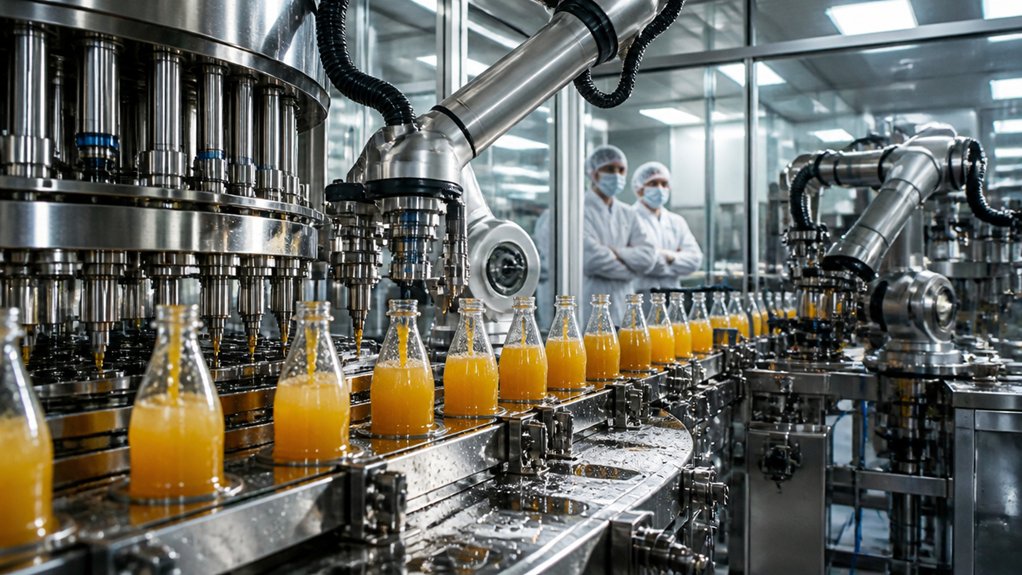
You can use automated filling systems to meter precise product volumes while maintaining throughput and reducing contamination risk.
Robotic packaging operations then place, seal, and label products with consistent speed and accuracy.
Together, these technologies help you adapt production lines to changing formats and demand.
Automated Filling Systems
How do robots fill and package food products with speed and precision? Automated filling systems coordinate product flow, container positioning, and dose control through sensors, programmable logic, and robotic arms. You can use volumetric, gravimetric, or flow-meter dosing to match a product’s viscosity and target fill level.
Vision systems verify container alignment and detect irregularities, while feedback controls correct deviations in real time. For hygienic operation, choose food-grade materials and washdown-rated components; configure clean-in-place cycles to reduce residue and contamination risks.
You’ll also need to validate fill accuracy across changing temperatures, line speeds, and product batches. Integrate robotic maintenance schedules to protect uptime, and provide workforce training so operators can adjust recipes, interpret alarms, and follow sanitation protocols.
This data-driven setup improves consistency while limiting spills, giveaway, and manual handling.
Robotic Packaging Operations
Once filling systems meter each dose, robotic packaging operations move products through case packing, tray loading, sealing, and palletizing with coordinated speed and precision.
You can integrate vision-guided arms to identify package orientation, verify counts, and place fragile goods without disrupting line flow. Sensors and programmable grippers adapt to changing formats, while conveyors synchronize each cell with upstream fillers and downstream inspection.
This packaging automation lets you switch products quickly, reduce repetitive handling, and maintain consistent pack quality. For heavier loads, robotic palletizing builds stable, traceable stacks according to configurable patterns, then transfers them for storage or shipment.
Connected controls record cycle data and flag faults, helping you refine throughput and respond to line changes. With hygienic designs and cleanable components, you can protect food safety while scaling production.
How Do Robots Clean Food Processing Lines?
When production stops, robotic cleaning systems use programmed motion, high-pressure spray, and detergent dosing to remove food residues from equipment and conveyor lines.
You can configure each robot cleaning cycle for specific surfaces, soil levels, and line layouts, then coordinate spray heads, brushes, and rinsing tools through controlled paths.
Sensors and flow meters help operators verify coverage, pressure, and chemical delivery, while programmable recipes make sanitation procedures repeatable across shifts.
For complex equipment, robots can reach beneath belts, around frames, and into other difficult access points, reducing manual scrubbing and worker exposure to cleaning chemicals.
You can also connect cleaning cycles to production schedules and maintenance systems, allowing teams to track cycle duration, resource use, and equipment status.
This data supports process adjustments and more efficient changeovers without disrupting planned operations.
How Do Robots Improve Food Safety and Quality?
Beyond sanitation, robots improve food safety and quality by limiting direct handling and controlling process variables with repeatable precision. When you automate cutting, portioning, filling, and packaging, you reduce opportunities for contamination from hands, tools, and inconsistent contact.
Robotics advancements also let you integrate machine vision, sensors, and real-time analytics to detect defects, verify fill levels, and monitor temperature or seal integrity. You can use these systems to maintain uniform product dimensions and processing conditions across shifts, supporting consistent texture, appearance, and shelf life.
Programmable recipes help you adjust parameters for different products while preserving validated limits. To meet Food safety regulations, you can connect robot records with traceability systems, creating auditable data on handling steps and process conditions. This visibility helps you identify deviations quickly and strengthen quality control.
How Do Robots Reduce Waste and Production Costs?
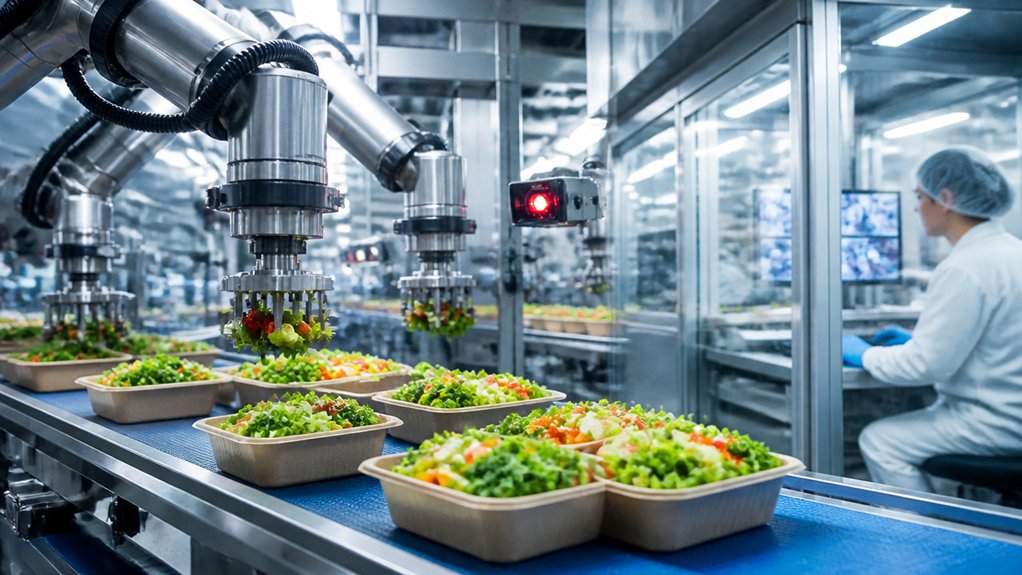
How do robots cut waste and control production costs? They execute repeatable motions with precise force, speed, and positioning, so you can portion ingredients accurately and reduce overfills, spills, and rejected products.
Vision-guided systems can identify irregular items and route them for rework rather than disposal, supporting waste minimization across sorting, cutting, and packaging.
Robots also sustain throughput without fatigue-related variation. You can coordinate picking, mixing, and case packing to limit bottlenecks, idle time, and excess work in process.
Sensors and production data help you detect drift early, adjust settings, and prevent costly batches from falling outside specifications.
Automated changeovers can shorten downtime and improve equipment utilization.
Together, these capabilities support cost reduction through more consistent yields, lower material loss, and better use of labor and machinery—while keeping output aligned with demand.
What Does It Take to Add Robots to a Plant?
Adding robots to a food or beverage plant starts with matching the application to production needs, product characteristics, and sanitation requirements. You’ll then assess cycle times, payloads, reach, and line interfaces to select equipment that fits your process.
Map product flow and pinpoint constraints before integrating robots with conveyors, sensors, and control systems. Design hygienic cells with suitable materials, sealed components, and access for cleaning and inspection.
Validate guarding, emergency stops, and food-safety procedures, then test the integrated line under realistic operating conditions. Plan robot maintenance around sanitation schedules, spare parts, and service access to protect uptime.
Your staff training should cover safe operation, changeovers, fault recovery, and cleaning protocols. Track performance after launch, using production data to refine robot paths, handoffs, and controls as product mixes or operating demands evolve.
How Can Smaller Plants Adopt Food Processing Robots?
Smaller plants can adopt food processing robots incrementally, starting with a repetitive, labor-intensive task such as case packing, palletizing, or product transfer. Choose an application with measurable cycle times, ergonomic risks, and quality requirements, then compare automation costs with labor and throughput data.
A compact collaborative robot or preconfigured cell can limit floor-space demands and simplify integration. You can pilot the system on one line, validate performance during actual production, and expand only when results justify investment.
Modular grippers and adjustable recipes help you handle changing products without replacing the entire setup. Plan for sanitation, washdown ratings, guarding, and food-contact materials from the outset.
Robotics maintenance schedules protect uptime, while staff training equips operators to manage changeovers, recognize faults, and work safely alongside automated equipment. Track payback and downtime consistently.
What’s Next for Food Processing Robots?
As sensors, machine vision, and AI improve, food processing robots will handle more variable products with less manual reprogramming. You’ll see systems adapt to changing ingredient shapes, textures, and temperatures while maintaining precise handling and consistent quality.
Food robot innovations will increasingly combine force sensing, predictive maintenance, and digital twins, helping you test process changes virtually before adjusting production lines. Collaborative robots will also take on delicate tasks near workers, with safety controls that respond to people and equipment in real time.
Industry collaboration will shape how quickly these capabilities reach your plant. Equipment makers, software developers, food producers, and regulators can align data standards, hygiene requirements, and validation methods.
As connectivity expands, you’ll need robust cybersecurity and traceable performance data. The next generation won’t simply automate tasks; it’ll help you optimize flexible, resilient production.
About the Author